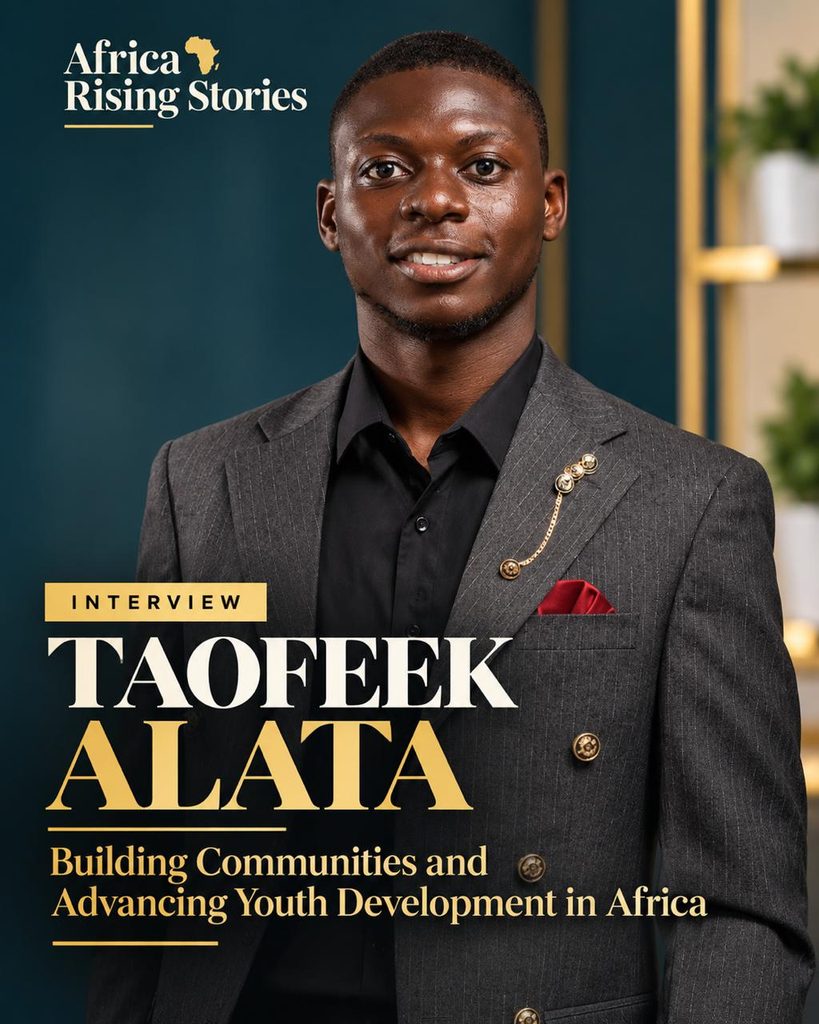
TAOFEEK ALATA: BUILDING COMMUNITIES AND ADVANCING YOUTH DEVELOPMENT IN AFRICA

Taofeek Alata is a Nigerian youth development advocate, community builder, and emerging leader passionate about creating opportunities for young Africans to participate meaningfully in shaping their communities and the continent’s future.
With over six years of experience in youth engagement, leadership development, community organising, and social impact, Taofeek has consistently worked to connect young people with knowledge, opportunities, and platforms to make meaningful contributions. From leading student-focused initiatives to building networks across institutions and facilitating access to international exposure, his journey reflects a commitment to ensuring that young people are not merely part of development conversations but active contributors to change.
His experiences have reinforced his belief that young people need more than ambition to succeed; they need access, information, collaboration, and opportunities to lead.
In this edition of Africa Rising Stories (ARS), we sat down with Taofeek to explore the experiences, values, and convictions driving his work. We spoke about his journey from growing up in a rural community in Ogun State to discovering new possibilities through international exposure, his experiences in student leadership, the importance of grassroots development, and his vision for youth participation in Africa.
It was an inspiring conversation about leadership, service, collaboration, and the responsibility to create opportunities for others.
ARS: Beyond the roles you hold and the initiatives you lead, what values drive you? What is at the heart of your commitment to youth development and community building?
Taofeek: At the heart of everything I do is a desire to make life better for people. I naturally dislike stagnancy. Every day, I ask myself how I can make something or someone better than I met them.
Growing up in a rural community in Ogun State played a big role in shaping this mindset. I understand what it feels like to have dreams but lack the exposure and support needed to pursue them. That experience made me a problem solver.
I believe development becomes much easier when young people are informed and empowered to organise themselves, collaborate, and take responsibility for their communities. That is really what drives my commitment to youth development and community building.
ARS: You have spent over six years working around youth development. What first made you realise that creating opportunities for young people was something you wanted to dedicate yourself to?
Taofeek: For over six years, I’ve always known that I don’t want to live only for myself.
Building a career is important, but I also believe that as young people, we have a responsibility to give back to the communities that shaped us.
I began to realise that transforming a community becomes difficult when the people within it don’t have the information, exposure, or capacity to contribute meaningfully. At some point, I decided I wanted to take responsibility for changing that narrative.
So, my approach has been simple: keep young people informed, connect them to opportunities, and create platforms where their contributions can reach beyond their immediate communities.
ARS: Many young people have ambitions but lack access and exposure. How do you think we can bridge the gap between the potential young people have and the opportunities available to them?
Taofeek: I can relate to this because I was in that position for a long time. Things changed for me when I got accepted to participate in the International Festival of Youth in Russia.
It was actually my first time travelling by air. I flew through Addis Ababa, Istanbul, and Moscow before eventually arriving in Yekaterinburg. That experience completely changed the way I saw possibilities.
I realised that many young people are not necessarily lacking potential. What they often lack is information, access, and the right connections.
I believe we can bridge that gap through proper guidance, strategic partnerships, international collaboration, and platforms that connect young people to opportunities beyond their immediate environment.
Since returning to Nigeria, I’ve remained committed to creating those kinds of connections for other young people. I believe the seeds I’ve planted since I got back will produce something significant very soon.
ARS: While at the University of Ilorin, you led the JCI Leadership Summit in 2024. What did that experience teach you about turning conversations on leadership into real community impact?
Taofeek: That experience taught me that I was capable of doing much more than I had initially imagined.
We brought together people from different professional backgrounds to have conversations around leadership, accountability, and responsibility. But beyond the conversations, we also encouraged participants to turn what they had learnt into practical community projects.
For me, one of the biggest lessons was discovering just how much impact you can create when you bring the right people together and give them the right structure.
It made me realise that there was so much more I could do, and that naturally increased my ambition. I haven’t stopped exploring those possibilities since then.
ARS: Your work has involved bringing together students from about 16 institutions across Kwara State. What does it take to build a community that extends beyond individual institutions and interests?
Taofeek: I think the foundation of building any community is having a shared purpose. People need to understand that their individual interests can contribute to something much bigger than themselves.
Bringing together students from 16 institutions was important to me because I wanted to create an environment where information, opportunities, and collaboration could move beyond the boundaries of individual institutions.
But I also believe advocacy shouldn’t end on university campuses. It needs to extend to marketplaces, businesses, organisations, and grassroots communities.
I used to tell my team that the more people we can inform, connect, and empower, the greater our collective capacity to create change. That’s something I strongly believe in.
ARS: You were involved in a Commonwealth programme that reached over 283 finalists. What difference does international exposure make in how young Africans see themselves and their possibilities?
Taofeek: I attended a Commonwealth summit in Lagos, Nigeria, and it was a really transformative experience for me.
I gained new perspectives, built meaningful networks, and had the opportunity to participate in personal development sessions. But I didn’t want to keep all that knowledge and exposure to myself.
I took what I had learnt back to Kwara State and started working towards creating similar opportunities for other students. We built collaborations with neighbouring student associations, which allowed more students to participate.
Eventually, over 283 finalists received certification.
I think that’s one of the biggest benefits of international exposure. It helps young Africans realise that their possibilities are not limited to the environment they grew up in or the communities they currently live in. It changes how they think and, more importantly, what they believe they can achieve.
ARS: As Chief of Staff to the President of the National Association of Kwara State Students, you supported representation for a large student population. What did that responsibility teach you about leadership, influence, and accountability?
Taofeek: One thing that experience taught me is that leadership is 15% about the authority that comes with a position and 85% about the responsibility that comes with it.
When you’re involved in representing a large population, you begin to understand that your decisions and actions go beyond your personal interests. You’re making decisions that affect other people, and you have to be conscious of that.
I learnt the importance of listening, strategic thinking, coordination, and accountability. You cannot genuinely claim to represent people if you’re disconnected from their realities.
ARS: Young people are often invited into development conversations but rarely given the power to shape decisions. What needs to change for youth participation to become more than just a seat at the table?
Taofeek: I think young people also have a responsibility to move beyond simply attending conversations and start demonstrating what they can actually contribute.
We need more young people investing in research, technology, innovation, community initiatives, and practical solutions to the problems around us.
But the responsibility doesn’t rest on young people alone. Institutions and decision-makers also need to create genuine opportunities for young people to influence policies and participate in their implementation.
Youth participation shouldn’t just be ceremonial. Young people need to be trusted with real responsibilities, given access to resources, and allowed to contribute to actual decision-making processes.
ARS: Africa has no shortage of conversations about its youthful population and demographic advantage. Are we doing enough to turn this potential into meaningful leadership and development?
Taofeek: Honestly, I don’t think we’re doing enough.
Africa has no shortage of conversations, conferences, policies, and development frameworks. But the real question is: how much of all these actually translates into measurable improvements in the lives of ordinary people?
I believe we need stronger grassroots engagement, better policy implementation, and more practical collaboration between governments, institutions, businesses, and young people.
Development cannot happen only in conference rooms. It has to reach the communities where the problems actually exist.
For me, Africa needs reforms that people can genuinely feel at the grassroots level.
ARS: Imagine you are in a room with young Africans who are eager to make a difference but are unsure where to begin. What three things would you want them to understand about leadership, service, and building a meaningful life?
Taofeek: There are three things I would want them to take away.
First, never underestimate the power of collaboration. When you walk alone, you might move faster, but when you walk with people, you can build something that outlives you. Sustainable development requires collective effort.
Second, build yourself before attempting to build others. Invest in learning, research, experience, and personal development. You cannot consistently give what you haven’t developed within yourself.
Third, never limit your imagination. Your present circumstances should not determine the extent of your ambitions. Believe in possibilities, remain intentional, and keep positioning yourself for opportunities.
Ultimately, Africa’s development requires people who are willing to learn, serve, collaborate, and take responsibility.
I want young Africans to understand that they don’t have to wait until they occupy important positions before they can make meaningful contributions. They can start from wherever they are, just like I did.
Still learning. Still growing.