Bologi Stephen: The Lawyer Who Kept Walking Into New Rooms

There is something slightly unexpected about Bologi Stephen’s career. On paper, it looks like several careers placed side by side: lawyer, communications professional, producer, talk-show host, writer, filmmaker, speaker and author. Look closer, however, and the pattern becomes clearer. Bologi has spent much of her life moving towards the place where words, people and ideas meet.
But the more I looked, the more I realised there was much more to the story than the list of titles suggested.
Long before the cameras, books and conversations, there was law.
Bologi studied Law at Babcock University, graduating with First Class Honours in 2014. But the decision to study Law was not as straightforward as her résumé might now suggest. She initially chose science because, in her words, she believed it was where smart students were supposed to belong. The problem was that she hated it.
So she moved to Arts.
It was there, while considering the possibilities in front of her, that she began to see Law differently. It was not exactly love at first sight. The love came with the journey, as she discovered that she could not only understand the law but become good at it.
Her father is a lawyer too, but he had never forced the profession on her. When she eventually chose it for herself, he was delighted. They would take walks together and talk about legal principles. One of the earliest lessons he gave her was the Latin maxim nemo dat quod non habet: you cannot give what you do not have.
It is a fitting detail when you look at the woman Bologi would eventually become. Much of her work has revolved around what people carry within them, what they give to others and the stories they tell about themselves.
After Babcock, she proceeded to the Nigerian Law School in Abuja. She also found herself doing something rather unusual for a young law student: participating in the Manfred Lachs International Space Law Moot Court Conference, presenting work that examined the second Air Malaysia crash within the framework of new space transportation systems under outer space law.
Then came practice.
Barely three months after being called to the Nigerian Bar, Bologi found herself appearing alone at the National Industrial Court.
She was terrified.
She had prepared as much as she could and arrived before 9 AM. Court sat at 9, and as a junior lawyer, she could not be coming at 9. But her matter was among the last to be called. By the time she finally stood up to speak at around 5 p.m., the fear had given way to fatigue. She did what she had come to do.
And discovered that it was not nearly as frightening as it had been in her head.
It would not be the last time Bologi walked into a room unsure of what would happen next.
Interestingly, if she had not become a lawyer, she says she might have studied psychology or theatre arts. She loved the stage and the arts, and imagined herself teaching, working with young people and doing something creative.
In a way, she ended up doing all of those things anyway.
Law gave her a foundation, but it did not contain her.
So, if you think Bologi simply waltzed into communications and media, think again. The storyteller had been at work long before the title became part of her professional identity.
Even while she was still building her career in law, the creative instinct was already finding expression. On 14 September 2020, she premiered Rings & Realities, a short film by Bologi Stephen. She was already telling stories through another medium, even before communications became the professional space in which much of that creativity would eventually live.
It is one of those details that becomes more interesting when you look backwards.
The lawyer was already making films.
The woman who would eventually build a career around communication was already looking for ways to tell stories.
Perhaps she was not changing direction as much as she was slowly revealing herself.
But Bologi has never seemed particularly interested in keeping what she knows to herself.
Her love for words has also found expression on stage. She performs spoken word, and there is something striking about watching a woman with a legal background stand in front of an audience and confidently deliver poetry. The courtroom is one kind of performance. The stage is another. Bologi has learned to inhabit both.
So when she eventually launched ELOQUENCE, her online virtual training programme focused on helping people speak confidently and eloquently, it did not feel like a completely new direction. She was taking something she had spent years practising herself and creating a way to teach it to others.
By then, she had already become a communicator, writer, filmmaker, speaker and spoken word artist. ELOQUENCE simply gave that part of her work another form.
And that is the interesting thing about Bologi. The more you look at what she has done, the less it feels like a collection of unrelated interests. The same instinct keeps showing up in different places. She tells stories. She facilitates conversations. She performs. She writes. She teaches people how to communicate.
That interest eventually took her to Canada, and this chapter of her life feels particularly significant because she was not simply starting over professionally. She was doing it as a new migrant and a new mother.
She was learning a new country, building a new professional identity and studying at Seneca Polytechnic, all while navigating the demands of motherhood.
It would have been easy to tell this part of the story simply as another academic achievement. Bologi graduated from Seneca with a 4.0 GPA, made the President’s Honour List and became valedictorian. But the numbers do not tell the whole story.
Behind them was a woman trying to hold several parts of life together at once.
She had already built a career in Nigeria. She was a lawyer, a communicator, a writer, a speaker and a mother. Then she moved into a new environment and chose to become a student again, learning a new professional field while also raising a young family.
Perhaps that is what makes the Seneca chapter so compelling. It was not simply about getting another qualification. It was about starting again without becoming a beginner in every sense.
She already knew how to work hard. She already knew how to communicate. She already knew what it meant to walk into unfamiliar rooms. But Canada gave her a different kind of unfamiliarity, and Seneca became one of the places where she began building again.
And she did not merely get through it. She graduated with a 4.0 GPA, made the President’s Honour List and became valedictorian.
There is an amusingly specific example of how her legal mind still shows up in her communications work. In one reflection on organisational culture, Bologi recalled that her first organisation had a signature font: Candara 11, in dark blue. Every email, legal opinion and internal document used it.
For someone else, it might sound like an insignificant detail.
For Bologi, it became evidence of something bigger. Small communication choices, she argues, reveal what an organisation values and how seriously it understands its own identity.
It is the kind of observation that makes sense coming from someone who has lived in both worlds. The lawyer notices the details. The communicator notices what those details say.
Her writing has also given her room to explore more personal questions.
In Validation Junkie, Bologi wrote candidly about her own struggle with the addictive desire for acceptance and affirmation. Rather than presenting validation as an abstract concept, she opened the door to her own experience and wrote about the process of finding freedom from the need to be constantly affirmed.
She called the alternative “GOD-lidation”, pointing readers towards the idea that approval from God should ultimately matter more than the approval of people.
Her books have since extended into other parts of life. She has written Hey Baby: A Love Journal from Parent to Child, and Different By Design: A Guide to Thriving in a Marriage of Opposites, co-authored with her husband, Peter Stephen.
And perhaps this is where the public Bologi and the private Bologi begin to meet.
She is a wife and mother, but family is not simply another line in her biography. Together with her husband, she has also built The Family Round Table, creating space for conversations around relationships, marriage and family. The work sits naturally beside the themes that have appeared throughout her writing and speaking: how people relate, how they communicate, how they navigate difference and how they build lives together.
There is something quietly revealing about that.
Bologi has spent years facilitating conversations, moderating discussions, telling stories and helping people find language for things that are sometimes difficult to say. Yet some of the most important conversations happen away from the microphone, inside a home, inside a marriage and in the everyday work of raising a family.
Her latest book, Audere, takes another turn. Published in 2026, it looks at the lives of biblical women including Miriam, the daughters of Zelophehad, Jael, Naomi and Rahab, drawing out themes of fear, risk, grief, faith and authenticity. But once again, Bologi does not remain outside the stories she tells. She brings her own experiences into the book, exploring what it means to dare while still being human.
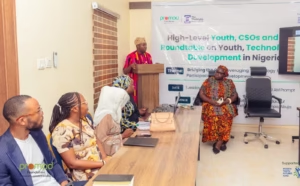
Bologi has continued to occupy spaces that might appear unrelated from the outside. She can be on stage performing spoken word and, at the same event, moderating a conversation about how Black entrepreneurs can lead in the AI economy. She can teach people to speak confidently through ELOQUENCE, move from corporate communications to conversations about marriage and family, from writing to mentoring young people, from a legal background to storytelling.
And yet, perhaps they are not unrelated at all.
The common denominator is not the job title.
It is words.
She has used them to argue a case, tell a story, write a book, speak on a stage, teach and facilitate conversations.
That may also explain why her career never settled into the conventional path she once imagined.
Years ago, she thought smart students were supposed to study science.
She was wrong.
She hated science, moved to Arts and eventually found Law. Then Law led her to other places she could not have anticipated. Communications. Film. Writing. The stage. Canada.
Perhaps that is the thread.
Not that she has always known exactly where she was going, but that she has been willing to pay attention when something else began to pull at her.
Maybe she was working a script she had never consciously written.
The interesting part is that the clues were there long before she knew what to call them.
She just kept following them.