Kingsley Ibe Is Taking a Nigerian Fintech Into East Africa to Build Better Lending Infrastructure
When Kingsley Ibe and Lionel Orishane founded CreditChek in 2021, the company set out to solve a fundamental problem in African lending: financial institutions often do not have enough reliable information to understand the people and businesses they are considering lending to.
Five years later, the Nigerian fintech is taking that ambition beyond its home market.
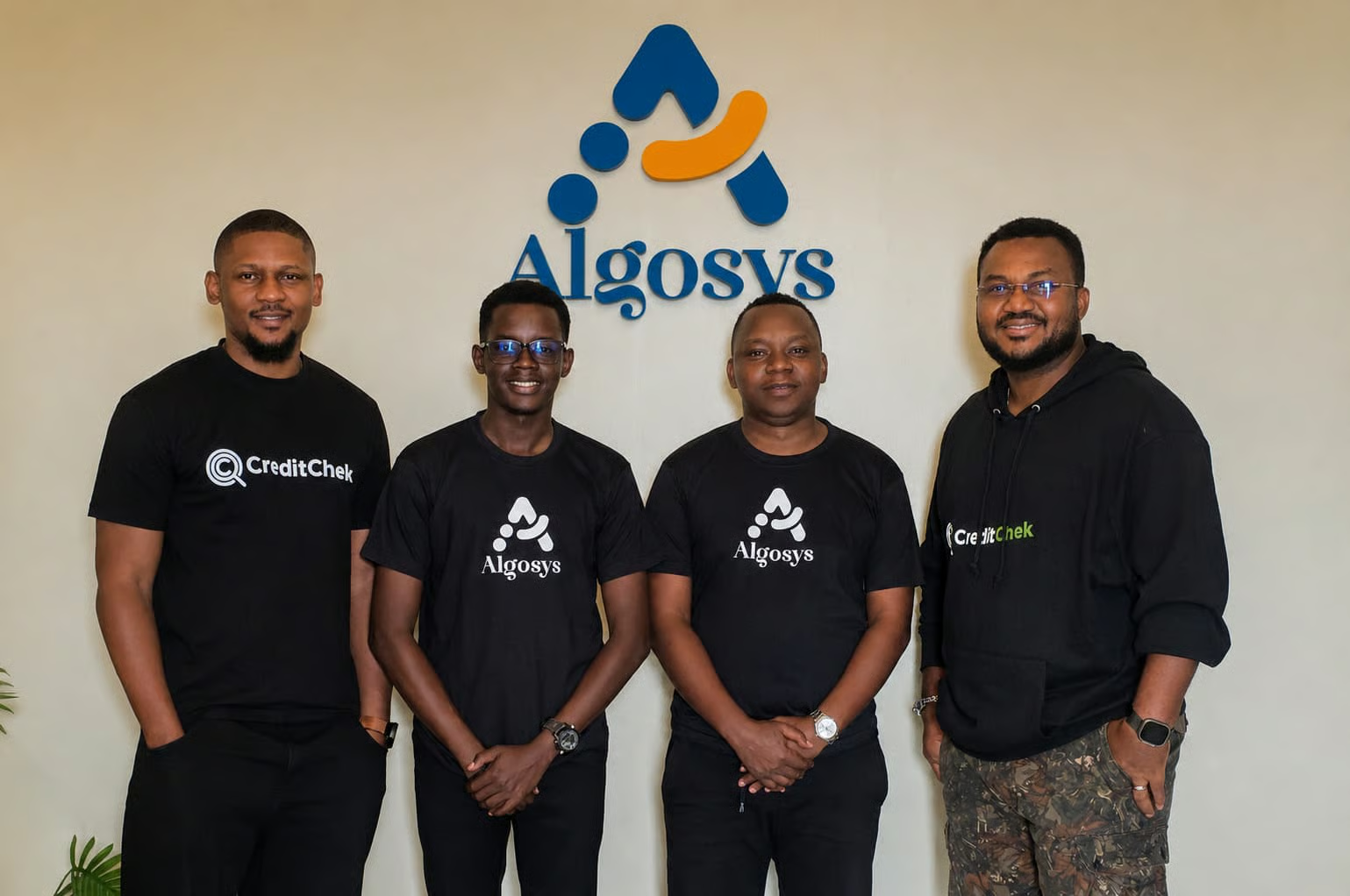
CreditChek has acquired Ugandan core banking and lending software company Algosys in a move that marks its formal entry into Uganda and the beginning of its wider expansion across East Africa. The financial terms of the acquisition were not disclosed.
Founded by Ibe and Orishane, CreditChek provides financial institutions with access to credit, income and identity intelligence, aggregating information from credit bureaus, financial institutions and alternative data providers into a unified infrastructure for credit decisions.
The company says it has processed more than $60 million in credit applications across one million individual profiles and has already achieved profitability in Nigeria.
The acquisition of Algosys represents a significant shift in the company’s ambition.
Rather than focusing only on helping lenders decide whether someone is creditworthy, CreditChek wants to participate in more stages of the lending process, including customer acquisition, risk assessment, credit decisions, loan origination and loan management.
“We want to move beyond simply providing data to lenders and build the infrastructure that enables them to acquire customers, assess risk, make credit decisions, originate loans and manage those loans throughout their lifecycle,” Ibe said.
That broader vision is where Algosys comes in.
Founded in 2024 by Innocent Bigega and Simon Tayebwa, Algosys provides core banking and lending software to financial institutions in Uganda. The company currently serves 22 financial institutions, including lenders, microfinance institutions and SACCOs, and its platform has facilitated more than 10,000 SACCO loans.
The combination gives CreditChek an established presence in the Ugandan financial sector while adding core banking capabilities to its existing credit and financial-data infrastructure.
Algosys will continue operating as a subsidiary of CreditChek and will continue serving its existing customers. The two companies will also explore ways to introduce CreditChek’s credit and lending capabilities to the financial institutions already using Algosys.
For Bigega, the acquisition creates an opportunity to combine the company’s local market relationships with a broader technology platform.
“Joining CreditChek gives Algosys access to a broader technology platform and resources while allowing us to continue building for the financial institutions we already serve,” he said.
The acquisition also reflects a growing challenge within African financial markets.
People increasingly use multiple financial channels, including banks, mobile money platforms, SACCOs and other digital services. Yet information about their financial activity can remain fragmented across those systems.
For lenders, this can make it difficult to build a complete picture of a potential borrower’s financial behaviour.
Uganda provides a particularly interesting environment for this challenge. The country had 34.6 million active mobile-money subscribers in 2025, compared with approximately 24 million bank accounts, while World Bank data shows that 67.7 per cent of Ugandan adults had a mobile-money account in 2024.
CreditChek believes that financial infrastructure designed around these realities can help lenders make better-informed decisions without relying solely on traditional banking records.
But the company is also conscious that African markets cannot simply be treated as copies of one another.
“East Africa is not one market; every country has its own financial behaviour, data sources, regulatory environment and lending dynamics,” said Orishane, CreditChek’s CTO and co-founder.
The company therefore says its approach will be to build infrastructure that is locally relevant while creating a common technology layer that can eventually operate across multiple African markets.
Uganda is the first step.
CreditChek raised $600,000 earlier this year to expand its financial data infrastructure across East Africa, with plans to enter markets including Kenya, Tanzania and Rwanda before eventually expanding into Francophone Africa.
For CreditChek, the acquisition provides both technology and market access.
For Algosys, it provides additional resources and access to a wider financial technology ecosystem.
And for the financial institutions using the combined platform, the longer-term proposition is a more connected set of tools for understanding customers, making lending decisions and managing loans.
The move is also another example of an African technology company expanding across the continent by acquiring local expertise rather than simply exporting its existing product into a new market.
That approach could become increasingly important as African fintech companies mature and begin looking beyond their original markets.
The opportunity is no longer simply to build individual financial technology products for individual countries. It is to build infrastructure that can work across different financial systems while still adapting to the realities of local markets.
For Ibe and Orishane, Uganda is the beginning of that next chapter.
What started as a Nigerian company focused on helping lenders make better credit decisions is now becoming a broader attempt to build the infrastructure behind lending across Africa.
The ambition is straightforward: make it easier for financial institutions to understand their customers, make informed lending decisions and manage credit — while building technology that reflects the way Africans actually earn, save, borrow and transact.
And with its first acquisition in East Africa, CreditChek is taking that ambition into a new market.