Beyond 200 Women: How MTN Foundation and UN Women Are Building New Economic Opportunities for Rural Women
For many women in rural communities, the challenge is not a lack of hard work. It is what happens after the work is done.
A woman may cultivate rice or cassava, process what she can with limited tools and sell what she produces within a small local market. She may have the knowledge, the labour and the determination to grow, but without access to better equipment, finance, digital tools, business knowledge and larger markets, turning that effort into sustainable income can remain difficult.
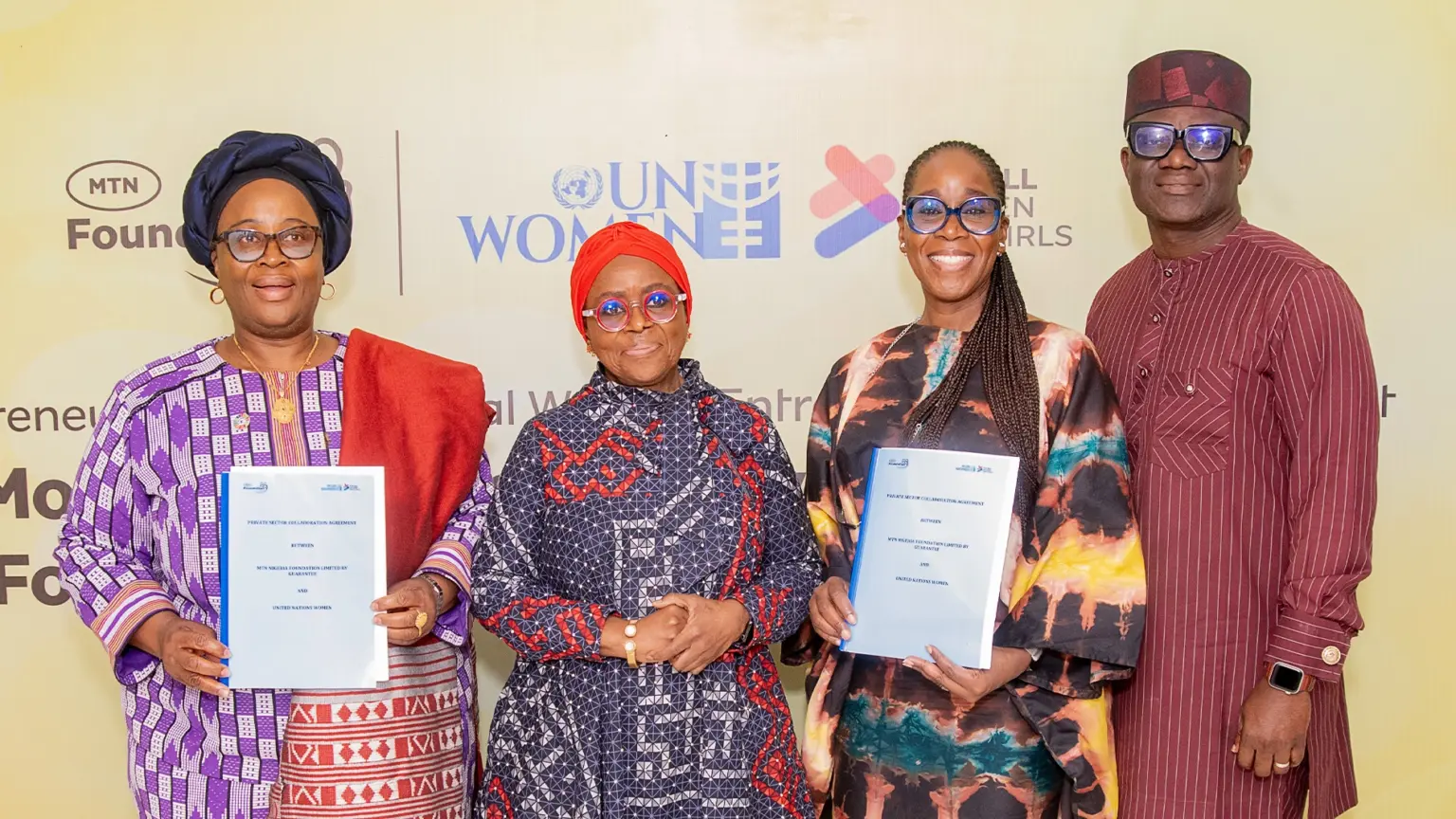
It is this gap that the MTN Foundation and UN Women are seeking to address through a new partnership aimed at supporting 200 rural women across Kano and Cross River states.
But the initiative is designed to be about more than putting money in the hands of women.
At its centre is an attempt to change what women are able to produce, how they produce it and, importantly, how much value they can capture from their work.
Under the partnership, women in selected communities will receive business training alongside support for digital and financial inclusion and access to markets. Processing hubs will also be established to help them move from subsistence production towards producing finished goods that can enter larger value chains.
In Kano, the focus will include helping women process, package and market rice. In Cross River, a processing hub will support the transformation of cassava into products that can be supplied to manufacturers.
That shift—from selling raw produce to creating products with greater value, is central to the potential impact of the intervention.
For the women directly involved, it could mean better production capacity and new routes to market. For the communities around them, the processing facilities could create an economic resource that extends beyond the original beneficiaries.
Odunayo Sanya, Executive Director of the MTN Foundation, described the thinking behind the initiative as an effort to reach women who are often further away from the opportunities available to entrepreneurs in urban centres.
The Foundation has previously focused on helping female entrepreneurs gain access to capacity building, funding and markets. According to Sanya, its programmes have built the capacity of more than 6,000 female entrepreneurs and provided about ₦304 million to 122 women entrepreneurs. It has also established a ₦1 billion matching fund for women entrepreneurs.
The rural intervention represents an expansion of that approach.
Rather than treating rural women simply as recipients of financial assistance, the partnership is designed around infrastructure, skills and access—elements that can potentially continue creating value after the programme itself ends.
That distinction matters.
Financial support can help a business survive a difficult period, but access to productive equipment, knowledge and markets can change what a business is capable of doing in the first place.
The processing hubs are therefore expected to play a role beyond the 200 women formally participating in the programme. Other women in the surrounding communities will also be able to access the facilities, potentially expanding the economic reach of the intervention to thousands of people.
This is where the initiative begins to look less like a conventional empowerment programme and more like an attempt to build local economic infrastructure.
When women have access to processing equipment, they can potentially move further along the agricultural value chain. When they have market information and business training, they are better positioned to understand what buyers need. When financial and digital tools become more accessible, they gain additional ways to manage, market and grow their businesses.
UN Women’s Country Representative to Nigeria and ECOWAS, Beatrice Eyong, emphasised another dimension of the programme: inclusion in the digital economy.
For rural women, digital exclusion can compound existing economic disadvantages. Limited access to information, financial services, markets and technology can make it harder to compete in an economy that is becoming increasingly digital.
The partnership therefore places digital inclusion alongside finance, business training and market access.
Eyong argued that development cannot be effective when significant parts of the population are excluded from emerging opportunities. Her point speaks to a wider challenge facing Nigeria: economic growth cannot be fully realised if women, who make up roughly half of the population—are unable to participate meaningfully in it.
There is also an intentional community dimension to the programme.
MTN Foundation says men in the participating communities will be engaged and encouraged to support the women, recognising that economic empowerment does not happen in isolation. A woman may receive training or gain access to a processing facility, but the social and economic environment around her can influence whether that opportunity translates into lasting change.
Ultimately, the ambition is larger than the number attached to the programme.
Two hundred women are the direct beneficiaries, but the processing facilities could serve many more. The products created through the intervention could connect rural producers to manufacturers and larger markets. And women who gain new skills and access to economic opportunities could, in turn, create opportunities for others around them.
That is the more interesting story behind the partnership.
It is not simply about empowering 200 rural women.
It is about what becomes possible when women who have spent years producing with limited resources finally gain access to the infrastructure, knowledge and markets needed to turn production into enterprise.
If the model delivers on its promise, the most significant outcome may not be the number of women who complete the programme.
It may be the new economic activity created around them.