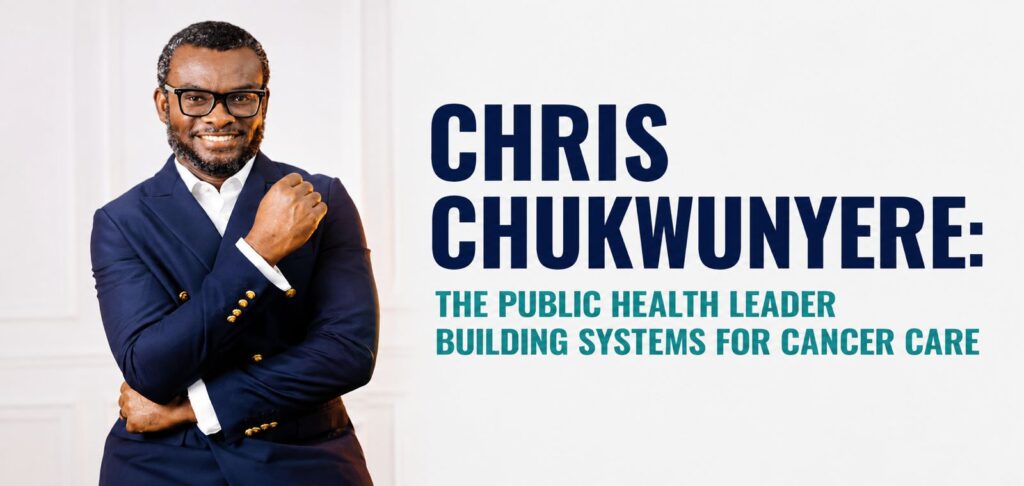
CHRIS CHUKWUNYERE: THE PUBLIC HEALTH LEADER BUILDING SYSTEMS FOR CANCER CARE
Chris Chukwunyere’s career has never been confined to one lane.
It began in the laboratory, moved into community health, expanded into international development and global health, crossed into cancer control, research and public health advocacy, and has now brought him to the centre of efforts to strengthen cancer care in Abuja.
Over more than 15 years, he has worked across Nigeria, Liberia, Zambia, Switzerland and the United States, building experience across health systems strengthening, programme management, global health security, research, strategic partnerships and resource mobilisation.
But beneath the different roles is a consistent interest: how can we build better systems that improve people’s lives?
Chris trained as a Medical Laboratory Scientist, earning his Bachelor’s degree from Imo State University in 2007. His early career as a clinical laboratory scientist gave him a close view of healthcare at the primary, secondary and tertiary facility levels. On joining Pro-Health International as Programme Officer, he got exposed to healthcare at community level where he travelled to over 60 rural and underserved communities across 32 states in Nigeria, coordinating free medical intervention projects. Later he switched into the infectious disease space as Public Health Officer in the same organization, where he worked with the Federal Ministry of Health, the infectious disease institute, development partners and relevant stakeholders to strengthen the public health emergency preparedness capacities across points of entry in Nigeria.
That experience would eventually take him beyond the delivery of healthcare into the larger world of programme design, policy, partnerships and systems development.
Over the years, Chris has worked across infectious disease control, global health security, health communication, programme management and development. His work has involved organisations and partners including the U.S. Centers for Disease Control and Prevention, the CDC Foundation and the Maryland Department of Health, among others.
The more he worked within public health, the more his focus expanded from individual programmes to the systems behind them.
Who makes the decisions? How are resources mobilised? How do institutions collaborate? What happens when a programme ends? And, perhaps most importantly, are the people the system is designed to serve actually being heard?
Those questions have shaped much of his career.
His international experience grew through opportunities including the Atlas Corps Fellowship, where he joined the 2019 cohort hosted by Susan G. Komen, and the StartingBloc Fellowship. These experiences connected him to global networks working across social impact, leadership and development.
His work with Susan G. Komen also marked an important chapter in his relationship with cancer.
He contributed to global cancer-care programmes, gaining experience in areas including cancer communications, navigation and survivorship. He later worked with the African Women’s Cancer Awareness Association, where he designed, implemented and evaluated projects and led efforts that raised more than $1 million.
For Chris, however, cancer was never simply another area of professional interest.
It was personal.
His wife’s mother died from breast cancer, and he later lost an uncle to prostate cancer.
He had seen firsthand what cancer could mean for a family, the uncertainty, the emotional toll and the cost of navigating a disease that can place enormous pressure on patients and the people around them.
That personal connection gave even greater meaning to the professional work he was already doing.
Then came another major chapter: COVID-19.
During the pandemic, Chris became increasingly involved in the challenge of health misinformation, vaccine hesitancy and health literacy. Through Inspire World International Foundation, the organisation he co-founded, he worked on community engagement and health-information initiatives.
In 2023, Brown University’s Information Futures Lab selected him as an Information Futures Fellow.
His fellowship focused on developing youth-led approaches to tackling health information needs in Nigeria. Brown documented his broader COVID-19 work as involving 11 projects that reached more than 22,000 people in person and 200,000 virtually.
But the significance of the work went beyond the numbers.
Chris was interested in what happens when young people are not simply told what information to believe, but are equipped to become credible sources of information within their own communities.
That interest in community participation eventually extended into research.
He has contributed to peer-reviewed research examining vaccination perceptions and strategies for improving vaccine uptake in northern Nigeria, as well as research exploring health conditions and health-information needs among people who inject drugs.
It is another indication of how his career has evolved, from delivering programmes to also asking questions about what works, why it works and how evidence can be used to make interventions better.
One outstanding thing about Chris is that he is a builder. He has over the course of his career built systems, organizations, platforms and people.
He is the Co-Founder of Inspire World International Foundation, an organization he co-founded with his wife. IWIF works across health interventions, economic empowerment and community development.
He has over the years developed valuable skills that today make him an excellent consultant, trainer, speaker, mentor and coach.
And he writes.
Chris is the author of 11 books, including Youth-Led Community Health Needs Assessment: A 10-Step Approach, which draws from his Brown University fellowship and more than 15 years of development experience. The book documents a youth-led assessment conducted across 40 communities in seven states and the Federal Capital Territory and turns that experience into a practical resource for others working in community health.
His professional journey has also been shaped by continuous learning. Beyond his degrees in Medical Laboratory Science, Business Administration and Public Health, he is an alumnus of Brown University’s Information Futures Lab, Atlas Corps, Presidential Precinct and StartingBloc, among other programmes. He is also a Fellow of the Chartered Institute of Project Managers of Nigeria.
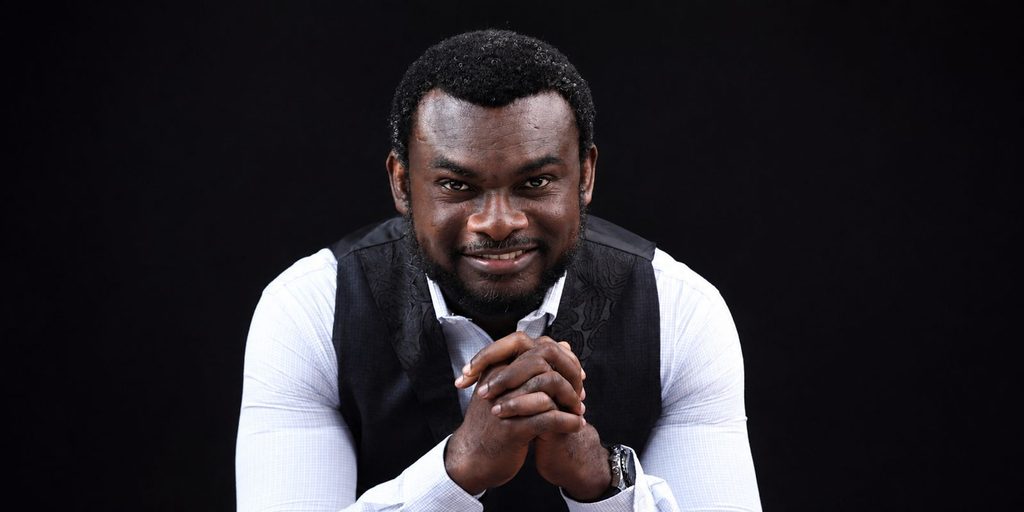
Today, all these experiences converge in his work with City Cancer Challenge (C/Can).
Chris became City Manager for Abuja in November 2023, taking on the responsibility of coordinating the local implementation of C/Can’s work to strengthen cancer care in the city.
It is a role that requires more than knowledge of cancer.
It requires the ability to bring different people and institutions together, government, healthcare professionals, civil society, development partners, academia, the private sector and, importantly, patients.
Under the Abuja programme, cancer patients have been engaged in understanding the realities they face within the city’s healthcare system, ensuring that the patient’s experience is part of the conversation about what needs to change.
In May 2026, Abuja launched nine priority cancer-system strengthening projects alongside three major assessment reports, bringing together more than 110 stakeholders.
For Chris, this is where years of experience in public health, programme management, partnerships, research and advocacy come together.
He is not simply working on a cancer project.
He is helping coordinate the people and institutions needed to make an entire system work better.
And he is taking that conversation beyond the professional spaces where these decisions are made.
Through The Good Disruptors, his podcast, Chris explores the realities and challenges surrounding health systems, especially in cancer care, asking questions about the issues that often sit beneath the statistics, and sharing practical ways of strengthening the health system.
The podcast is an extension of the work he is already doing: creating space for people to question existing systems, understand complex issues and imagine better ones.
Looking at Chris Chukwunyere’s career as a whole, it is difficult to reduce him to a single title.
He is a public health professional who became an international development strategist. A cancer advocate who became a health-systems practitioner. A researcher who works with communities. A nonprofit leader who is also an author. A speaker and coach who continues to work on some of the most complex health challenges facing communities.
But perhaps the strongest thread through all these chapters is his movement from understanding problems to building solutions.
He started by understanding health through the science of the laboratory.
He moved closer to communities.
Then into programmes, organisations and international development.
Then into research and global health.
And today, he is helping to shape how cancer care is delivered in one of Africa’s major capital cities.
His career is still unfolding, but the direction is clear.
Chris Chukwunyere is building a career around people, health and the systems that connect them, using experience, evidence, partnerships and personal conviction to help make those systems work better.
And perhaps that is what makes his journey worth paying attention to: he has not simply built a long career.
He has continued to expand the size of the problem he is willing to help solve.