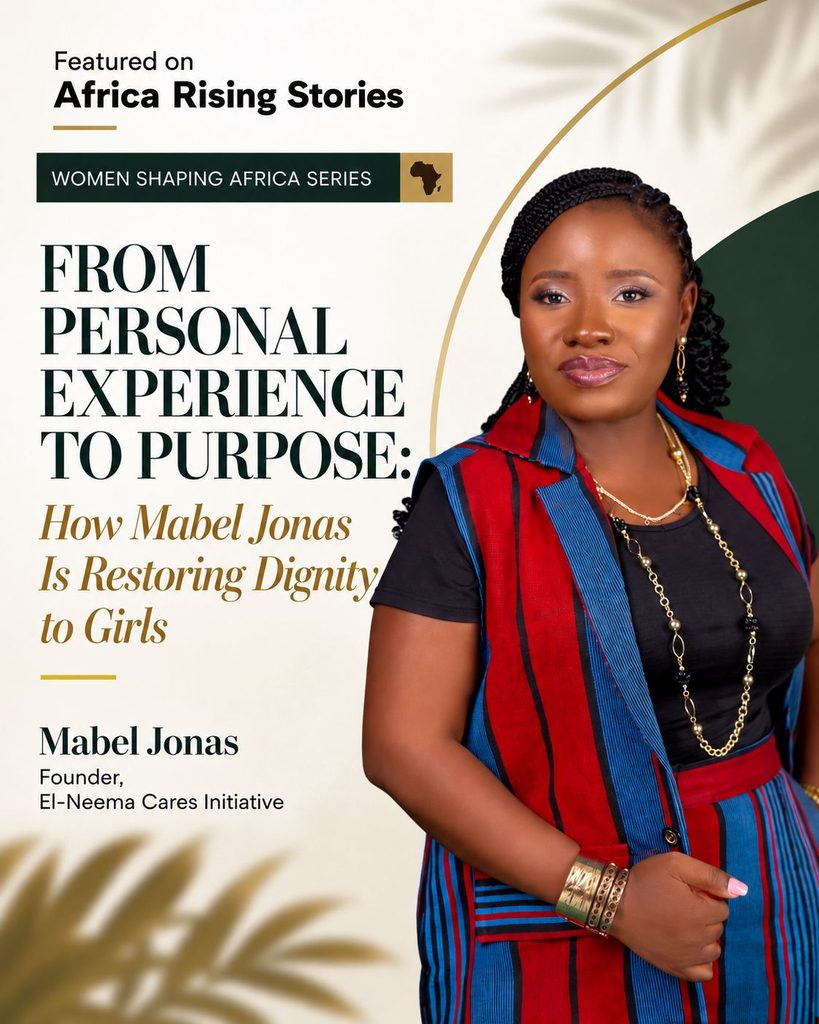
FROM PERSONAL EXPERIENCE TO PURPOSE: HOW MABEL JONAS IS RESTORING DIGNITY TO GIRLS
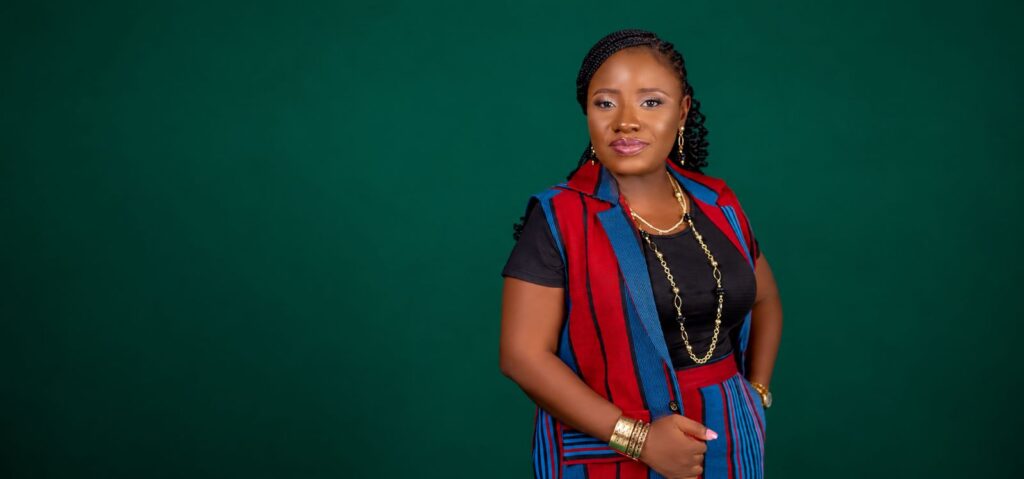
For Mabel Jonas, the work she does today is deeply connected to a memory she has carried since childhood.
As a Primary 6 student experiencing her first menstrual period, Mabel found herself without a sanitary pad and too afraid to ask for one. Years later, that experience would become more than a childhood memory, it would become part of the conviction that led her to establish El-Neema Cares Initiative and dedicate her work to restoring dignity to girls and women facing menstrual poverty.
But Mabel’s story is not only about menstruation. It is also about service, compassion, inclusion and the decision to respond when you encounter a problem that others have learned to overlook. From her early experiences of receiving unexpected kindness to her work taking menstrual health support into schools, markets and underserved communities, her journey reflects a belief that meaningful impact begins with seeing people and responding to their real needs.
In this conversation with Africa Rising Stories (ARS), Mabel takes us behind El-Neema Cares Initiative to talk about the experiences that shaped her, the realities she has encountered on the ground, the meaning of dignity, the challenges of building a grassroots organisation and the future she hopes to create for the girls and women she serves.
ARS: Before there was El-Neema Cares Initiative, there was Mabel Jonas. What experiences, encounters or moments in your own journey shaped your understanding of service, and ultimately made you feel a responsibility towards women and girls whose needs are so often overlooked?
MJ: First, when I was in Primary 6, one day my flow came. That was my first time. I had heard of menstruation before then, though the knowledge I had was limited. However, I knew that I needed a sanitary towel to stay clean and dry. There was no pad in view, and I didn’t get a tissue in the washroom. I was too shy to ask anyone to give me one for fear of stigmatisation. So, I brought out a book from my bag. I had wrapped it with a newspaper then. I removed the newspaper, folded it neatly, sprinkled water on it to make it soft, and then I put it on. That was what I used till I got home and my mom gave me a pad to use. This experience I never forgot. It stayed in my heart and became a passion till it birthed the organisation where we look out for the menstrual needs of young girls.
Secondly, towards service, I remember getting stained one of the days when I was in secondary school. I had left my class to greet my friend in another class. As I wanted to stand up, someone discovered I was stained. Ah!!! I sat back immediately. Everyone began to leave the class as we had closed, but I couldn’t. Then a student walked up to me. She wasn’t feeling well, which made her wear her cardigan to class. She removed it and gave me to tie on my waist, so I would be able to stand up and go back to the hostel. That act left an imprint in my heart and, yes, shaped my understanding of service.
ARS: In 2022, you turned that conviction into El-Neema Cares Initiative. What was the moment, or the accumulation of experiences, that made you realise that caring about the problem was no longer enough, and that you had to build something to respond to it?
MJ: I actually started in 2019 when I was serving my country (NYSC) in Babban Saura community of Kaduna State. It only became registered with the CAC of Nigeria in 2022. While serving, I taught mathematics for senior class and home economics for junior class. I was surprised when I taught them the topic on menstrual hygiene and most of them didn’t know what pad was or the types of sanitary towels. A lot of them at the time had never used a pad. In their words, “Aunty, we don’t use pads, we use rags.” My heart sank because I know these materials are not hygienic for them. And then, I knew I needed to do more than just caring—to build a system that would bridge the knowledge gap on menstruation and provide menstrual hygiene kits.
ARS: You have spent time in schools, markets and underserved communities, sitting with girls and listening to their experiences. What have those conversations taught you about period poverty that no report, statistic or policy document could have prepared you for?
MJ: It has taught me that period poverty is far more than lack of access to sanitary products. Reports and statistics can show the scale of the problem, but those conversations reveal its deeply personal and emotional reality. I learnt that for many people, menstruation is accompanied by anxiety, embarrassment and difficult choices. Some have to choose between buying menstrual products and meeting other basic needs, while others miss school, work or social activities because they lack adequate protection.
ARS: You could describe your work simply as providing menstrual products, yet you consistently use the language of dignity. Why is dignity at the heart of your work, and what does it mean to restore dignity to a girl who is struggling with something as basic as managing her period?
MJ: From my past experience earlier mentioned, I knew what I went through when I got back to class. I couldn’t walk well because of the discomfort; I couldn’t concentrate as I just wanted the class to be over so I could go back home and wash up properly. For a moment, I lost myself and my esteem simply because I was on my flow. This shouldn’t be the plight of any girl child. Whether on her flow or not, girls ought to be confident in themselves and, yes, that’s why I try as much as I can to provide menstrual kits and wash materials for girls which would help them stay clean, safe and dry and maintain their dignity.
ARS: At one of your market outreaches, girls shared that they use tissue paper during their periods or stretch one pack of sanitary pads across two menstrual cycles because they cannot afford enough. When you hear stories like these repeatedly, how does it change the way you think about the problem, and what responsibility do you feel as a person leading this work?
MJ: It makes me realise that I cannot treat menstrual poverty as just a social issue: it is a reality affecting girls I have looked in the eyes. It has made me feel responsible to keep showing up, listening and doing whatever I can to restore their dignity.
ARS: Your interventions connect menstrual support with education, self-worth, self-discovery and career awareness. Why was it important for you to look beyond the immediate need and ask what else a girl needs to thrive?
MJ: Because it’s not just about providing the kits for them. I won’t always be there and they may return back to the use of unhygienic materials, so the need to create educational awareness is even more important. Because if they have the foreknowledge, it will inform their decisions to get hygienic materials for themselves and not because I gave them or told them to do so. When they see the need, they will make adequate preparation for their monthly flow so they don’t miss out on anything educational happening when they are on their flow.
ARS: You translated The Neema’s Menstrual Booklet into three indigenous Nigerian languages and French. What did that decision reveal to you about the people who are often unintentionally left out of development interventions, and what does truly inclusive impact mean to you?
MJ: It revealed that language can quietly become a barrier to participation and impact. This is because solutions are designed around the language, culture, literacy level or assumption of the people who are easiest to reach. Inclusive impact for me is moving beyond simply making something available and asking: who might be unable to use this? Whose voice have we not heard and what barrier are we creating without realising it?
ARS: Behind every community intervention is a founder carrying the weight of funding, logistics, partnerships, expectations and the realities of running a nonprofit. What has this journey demanded from you personally, and what have you had to become in order to keep El-Neema going?
MJ: The journey has demanded more from me than I initially imagined. It has required sacrifice, resilience, patience, courage and willingness to keep showing up even when the path is uncertain. To keep El-Neema going, I have had to become more resilient: to learn how to continue when resources are limited, when progress feels slow and when the outcome is not guaranteed. It has taught me to be a steward rather than simply a founder. I have learned that sustainable change is rarely immediate.
ARS: Impact is often reduced to how many girls were reached or how many pads were distributed. When you think about the work you have done since 2022, what change matters most to you, and is there a particular girl, woman or encounter that reminds you that the work is making a difference?
MJ: For me, what matters to me is that we are removing a barrier that can quietly affect education, confidence, participation and wellbeing. True impact for me is turning a basic necessity into dignity, confidence and opportunity. The change that most matters to me is moving people from being unintentionally left out to being intentionally included.
Yes, there’s a girl in Kaduna State with two younger ones, who lost their mom and after encountering us said, and I quote, “Ma, I vowed that my siblings will never use rags for their period and I ensure to save at least a thousand every month even though things are difficult, to see that I get them 2 packs every month, even if it means me starving.” Hearing that made me know that we are making progress, howbeit one girl at a time.
ARS: If El-Neema Cares Initiative succeeds beyond your wildest expectations, what will be different about the lives of the women and girls you serve, and when a girl looks back years from now and remembers encountering your work, what do you hope she remembers feeling about herself?
MJ: More women and girls will live with greater dignity without period poverty limiting their education or opportunities. I hope they remember that they were seen and valued and that their dignity truly matters.
ARS: Thank you, Mabel, for sharing your story with us.