The African Business and Human Rights Forum (ABHRF) at 5: Shaping Business and Human Rights (BHR) and Responsible Business Conduct (RBC) in Africa

Since 2022, the African Business and Human Rights Forum (ABHRF) have continued to position itself as the continental platform for convening, dialogue, exchange, deliberation, discussion, and networking to shape Business and Human Rights (BHR) in Africa. Over the past four years, the Forum has grown and evolved into Africa’s multi-stakeholder platform for BHR and Responsible Business Conduct (RBC).
The significant growth of the Forum between 2022 and 2025 not only reflects increased stakeholder engagement and commitment to the subject across the continent but also highlights key milestones achieved in advancing BHR policies and practices.
Across the world, similar Dialogues and Forums on BHR are happening at different levels and among diverse stakeholders. For example, the annual Global BHR Forum in Geneva, the Responsible Business and Human Rights Forum in Asia, the East African Dialogue on BHR and, more recently, the Arab States Dialogue on BHR.
While the levels, depths and scope of these conversations may vary across the world, these platforms, which also serve as advocacy spaces, underscore the importance of the United Nations Guiding Principles on BHR (UNGPs) and other international standards.
As we approach the 5th ABHRF, it is imperative that we reflect on how far we have come and what we have achieved through the Forum.
Establishing a platform for continental discourse
Every year, the team of Forum co-organisers (UNDP, OHCHR, UNICEF, UN Global Compact, UN Working Group on Business and Human Rights, African Union Commission (AUC), African Commission on Human and Peoples’ Rights (ACHPR) have always been intentional about the theme of the Forum and its implications on the broader BHR discourse in Africa.
Therefore, the intentionality applied towards the selection of the theme and scope of the BHR Forums has been a strategic move to ensure that each Forum builds on the success and theme of the previous one. For example, the Forum’s foundation was laid in Accra with an evaluation of the last decade of the UNGPs. At the same time, the Forum in Addis Ababa discussed anchoring the Forum in policy action, with an emphasis on Africa for Africa. This led us to Nairobi, where the Nairobi Declaration was developed as a call to action, and, more recently, to the 2025 Forum in Lusaka, which drew on the AU’s theme of the year on remedy and reparations, with an emphasis on translating commitments made in Nairobi into action. A working group and framework will be developed to implement the commitments made through the Nairobi Declaration
ABHRF at 5, From Commitments to Action
The ABHRF has been organised across three sub-regions of Africa (West, East and Southern Africa). This practice of hosting the Forum in different countries and sub-regions every year is one that the strategies that the ABHRF successfully pioneered and implemented to increase national ownership on BHR and also during the Forum, leverage it as a strategic advocacy platform to catalyse national action and commitments towards NAP development processes, increase engagement with CSOs, private sector and other key national stakeholders, and take into account the language, cultural, and regional nomenclatures of the African continent. In fact, in countries where the BHR Forum has been hosted, we have seen not only increased awareness of BHR but also greater uptake of developing National Action Plans (NAPs) on BHR and mainstreaming RBC.
The first ABHRF, which was held in Accra, Ghana, in 2022 under the theme “The African Decade: Shaping the next 10 years of business and human rights”, marked a monumental step in establishing the continental platform for African conversations and strategically positioning African engagement on BHR. The Forum brought together 350 delegates, including representatives from 45 African countries and 15 partners, for three days of deliberations and engagement to take stock of the first decade of the UNGPs. As the inaugural Forum, it was also an opportunity to create awareness on the UNGPs and deepen the understanding of delegates on BHR, evaluate ongoing national efforts towards the development of NAPs on BHR, promote Human Rights Due Diligence and show the linkages between the BHR agenda and the trade and value chains under the African Continental Free Trade Area (AfCFTA).
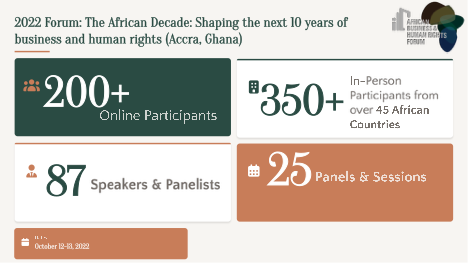
Organised at a critical time when the world was grappling with the effects of COVID-19 on its economies, the Forum showed that human rights issues cannot wait nor be swept aside in a global pandemic. It was also a critical time for BHR, as the UNGPs had just completed the first decade; it was an opportunity to reflect on the progress made over the first 10 years. In commemoration of this milestone, UNDP undertook the study “A Baseline Assessment on Business and Human Rights in Africa: From the First Decade to the Next” to assess the progress made on BHR in Africa.
In 2023, it became important to situate the Forum within the African context and specifically within the African Union. The AU designated 2023 as the year for “Acceleration of African Continental Free Traden Area (AfCFTA) Implementation” with the goal of accelerating the operationalisation of the AfCFTA to boost intra-African trade, enhance economic integration, and promote sustainable socio-economic development across the continent.
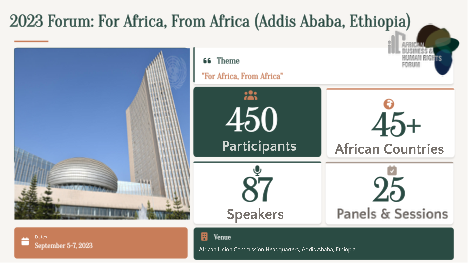
The Forum was organised at the African Union Headquarters in Addis Ababa, Ethiopia, with over 450 delegates, under the theme “For Africa, From Africa” with the goal of focusing on home-grown and Africa-centred solutions. The sessions of the Forum also explored new themes, including the rights of the child in the supply chain, the nexus between BHR and labour and migration, the interconnectedness of trade, regulations, and supply chains with conflicts, and the role of rights-holders in ensuring accountability.
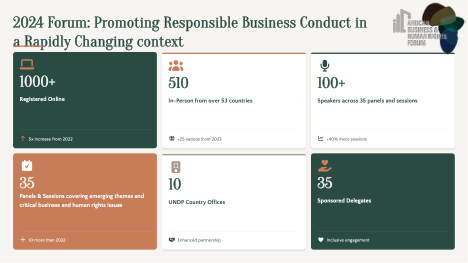
By 2024, we began to witness a shift in the development space, driven by the super-election year and a reprioritisation of government policies from development to security and defence. This refocus and reprioritisation led governments to place more emphasis on trade as the basis for development financing and Official Development Assistance (ODA). In line with these trends, the theme of the 2024 Forum centred on “Promoting Responsible Business Conduct in a Rapidly Changing Context” with the goal of addressing these changes and assessing their implications for the BHR agenda globally and specifically in Africa. The Forum brought together over 500 delegates and 100 speakers across 35 panels in Nairobi, Kenya. It also led to the development and endorsement of the Nairobi Declaration as a shared commitment by all stakeholders.
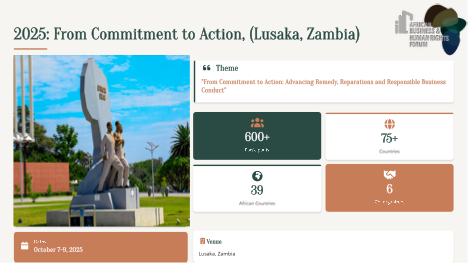
By the 4th iteration, held in Lusaka, Zambia, in 2025, the Forum made a strategic shift to move beyond expanding the conversation on BHR to delivering key strategic actions on BHR in Africa. Under the theme 2025 “From Commitment to Action: Advancing Remedy, Reparations and Responsible Business Conduct in Africa”. Over 620 delegates were in attendance, and the theme also aligned perfectly with the AU’s 2025 theme, “Justice for Africans and People of African Descent through reparations”. An integral part of the 2025 Forum was the opportunity to evaluate the Nairobi declaration.
- The success of the past four years underscores the Forum’s contributions to shaping the BHR agenda in Africa, including the adoption of NAPs. Since 2022, we have seen the development of three additional NAPs in Africa (Nigeria, Liberia, and Ghana), bringing the total to 5 (including Kenya and Uganda). These NAPs provide a roadmap for integrating the UNGPs into national policies and practices, thereby advancing the BHR agenda at the local level.
- Consequently, the decision to host the Forum across different countries validates this progress, as countries that have hosted or even participated in the Forum have seen an expedited commitment to the development of their NAP.
Leveraging the power of strategic multi-stakeholder partnerships
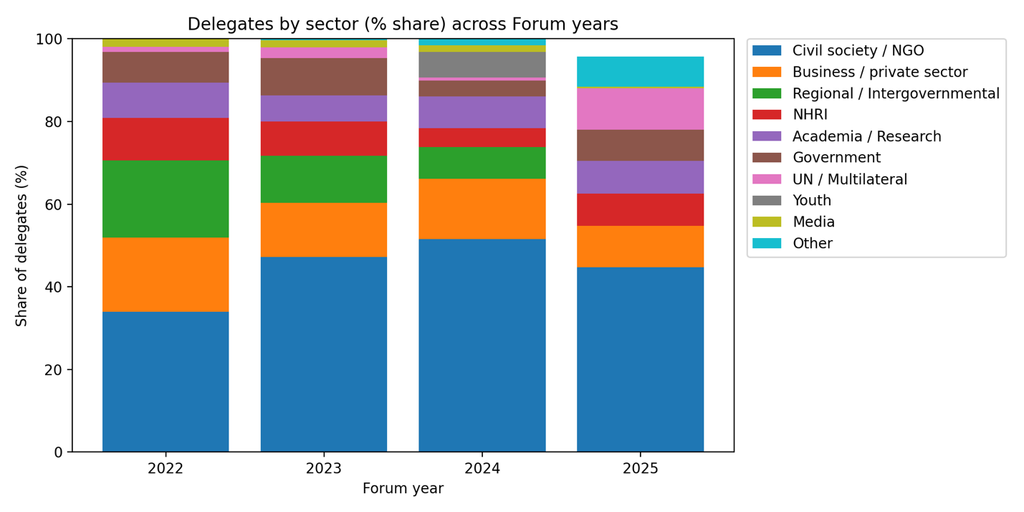
The success of the ABHRF has been largely due to strategic partnerships, engagement and collaboration with key stakeholders such as governments, the AU, the United Nations (UN), civil society, academia, the private sector, National Human Rights Institutions (NHRIs), law firms, trade unions, labour unions, etc.
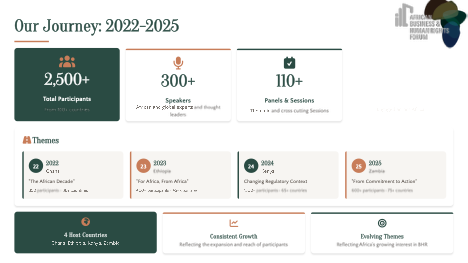
With this, over 2000 delegates and participants have attended the Forum (350 participants in Accra in 2022, 450 in Addis Ababa in 2023, over 510 in Nairobi in 2024 and 620 in Lusaka in 2025), reflecting how the Forum has evolved into a dynamic and vibrant regional space for dialogue and awareness-raising on the UNGPs.
Also key to this success is the UN-AU partnership, which is guided by the UN-AU collaboration framework, including the AU-UN framework on human rights. The co-organisers, who have led the charge in organising the Forum over the last four years, have not only leveraged the frameworks and mandates of each institution.
At the centre of this growth, progress, success and momentum from Accra to Lusaka in the span of 4 years is the investment in strategic partnerships, advocacy, regional leadership, multi-stakeholder engagement, inter-agency collaboration and coordination and the support of over 80 other partners which cut across Civil Society Organisations (CSOs), Faith-Based Organisations (FBOs), Law Firms, has proven to be a successful partnership model for the BHR Forum.
Action Aid International, Advocates for Community Alternatives, Advocates for International Development (A4ID), African Coalition for Corporate Accountability and Business (ACCA), African Commission on Human and Peoples’ Rights (ACHPR-Banjul Commission), African Resources Watch, AfDB/IRM, Alliance for Land, Indigenous, and Environmental Defenders, APRM, Arche Advisors, Association Paysanne des Jeunes Entrepreneurs Agricole, AVOCATS SANS FRONTIERES, Belgian Agency for International Cooperation – Enabel – Uganda, Business & Human Rights Resource Centre, Centre for Applied Legal Studies (CALS), Centre for Child Rights, Centre for Democracy and Human Rights, Centre for Environment Justice, Christian Aid, Church of Sweden, The Circulate Initiative, DanChurchAid, Danish Family Planning Association, Danish Institute for Human Rights (DIHR), ELS-TOGO, Ethical trading initiative, Federation of African Law Students (FALAS), Fellowship of Christian Councils and Churches in the Great Lakes and Horn of Africa, Foreign Commonwealth and Development Office (FCDO), Friedrich-Ebert-Stiftung (FES), FRIEDRICH-EBERT-STIFTUNG AU COOPERATION OFFICE (FES AU), Fundación Avina, GBI, GIZ-AU, Global Compact Network Kenya, Global Rights Compliance, HakiRasilimali, ICoCA – The Responsible Security Association, ILO, Indigenous People’s meeting, International Alert, International Federation for Human Rights, International Organisation of Employers (IOE), International Organization for Migration (IOM), IPIS, ITUC, KAS, Lawyers for Human Rights, Leigh Day, Mbuyisa Moleele, Lusophone Platform on Human Rights, MALAWI MISSION TO THE UN IN GENEVA, Network of African National Human Rights Institutions (NANHRI), Norwegian Church Aid, OECD, OECD Watch, OXFAM, Pan African Lawyers Union (PALU), Partner Africa, RAID, Rafto, ACT Alliance partners, Norwegian Church Aid, Rosa Luxenberg Southern Africa, RTDS, RWI, Thomson Reuters Foundation (TRF)/TrustLaw, Ubuntu Development Network (UDM), United Nations Global Compact (UNGC), United Nations Global Compact Network Kenya (UNGCNK), UN Voluntary Fund for Indigenous Peoples, Voluntary Principles, Webber Wentzel (South Africa), Zimbabwe Council of Churches, and the Zimbabwe Environmental Law Association (ZELA) with the UN Global Compact, International Organisation of Employers (IOE), Network of African National Human Rights Institutions (NANHRI),
These partners have helped sustain and strengthen not only the regional discourse on BHR but also engagement with national stakeholders and the development of NAPs, and, overall, turn commitments into action.
Looking ahead: What have we learned after 5 years
- Collaborative partnership translates into Ownership: The success of the ABHRF has been driven by partners’ collaboration and co-creation. The Forum has become an African space and voice for CSOs, indigenous communities, human rights defenders, faith-based organisations, law firms, to contribute to the broad discourse on BHR
- Regional Balance and Inclusion promote awareness and advocacy: The strategy of hosting the Forum across the continent has promoted regional ownership, inclusivity, and advancements in the Forum. Expanding the Forum to North and Central Africa and fostering subregional dialogues will further strengthen stakeholder engagement and regional cooperation. In addition, the Arab-Africa dialogue served as a good opportunity to further create synergy between the African and Arab experiences on business and human rights
- Autonomy and Alignment: For the Forum to remain a space of safety and neutrality, and an environment where stakeholders can freely engage in important discussions, we must maintain the Forum’s independence and neutrality as we engage with host governments.
- Sustaining Momentum: The ABHRF’s progress has shown that it is important to sustain the momentum behind the Forum. This momentum can be sustained through continued engagement with host governments, technical support, and peer-to-peer learning among governments. We will continue to encourage governments that indicate an interest in hosting the Forum and show commitment towards the localisation of the UNGPs, including through a contextualised and participatory NAP process.
- Innovative Financing: So far, the Forum has been funded with resources pooled from the co-organisers and partners. Despite the Forum co-organisers’ limited resources, the Forum has been a success because partners have committed additional funding to cover various costs related to the Forum. While this model continues to work, the co-organisers’ investments are important, as the Forum is a major deliverable with the potential to yield transformational results and engage the donor community, whose investments will further ensure sustained impact, scalability, and sustainability.
- Government engagement and ownership: The approach of engaging and working closely with governments, especially the ministries of justice, foreign affairs, other line Ministries and MDAs, has been instrumental in ensuring national ownership and the localisation of the agenda at the country level. We have seen increased uptake of the BHR agenda since the Forum in Ghana, Ethiopia, Mozambique, and most recently in Zambia.
- Country exchange and learning: The Forum has served as a platform for countries to not only engage in dialogue but also learn from each other. For example, the country engagement organised for government counterparts has served as a space for countries to learn from each other’s experiences. Another important example is the peer-to-peer exchange that the Forum facilitated for Nigeria and Ghana to engage on the NAP processes undertaken by both countries. The Forum has also contributed to shaping the global BHR Forum, particularly on discussions that concern Africa. The Forum is not just important to the African BHR space but also the global BHR space.
Opportunities and Next Steps
- Institutionalise the Forum as a yearly continental mechanism for assessing progress on the BHR agenda in Africa.
- Strengthening the capacity of duty- and responsibility-bearers and NHRIs to ensure that judicial reforms and access to remedies are strengthened.
- Continue to engage the private sector to increase their participation in the Forum through engagement with UNGC, IOE, and other stakeholders.
- Expand the discussions to include opportunities for youth engagement in the Forum to ensure accountability and ownership.
- As we plan for the 5th year of the ABHRF, it is important to look ahead, towards continuity, strategic initiatives, and expanded stakeholder engagement that will be essential to advancing progress, informing future strategies and engagement, and delivering concrete outcomes.